> For the complete documentation index, see [llms.txt](https://docs.chaingpt.org/llms.txt). Markdown versions of documentation pages are available by appending `.md` to page URLs; this page is available as [Markdown](https://docs.chaingpt.org/dev-docs-b2b-saas-api-and-sdk/solidity-llm-open-sourced.md).
# Solidity LLM (Open-Sourced)
## Solidity LLM (Open-Sourced)
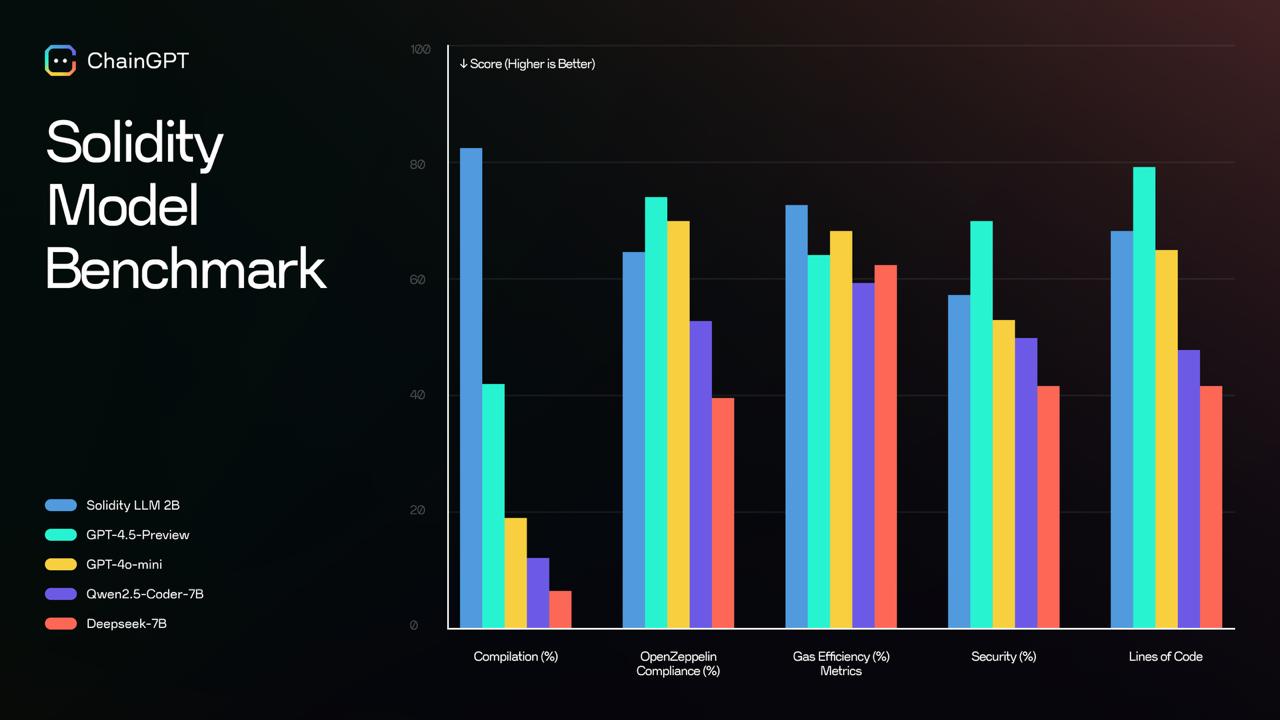
Solidity LLM is a specialized Large Language Model (LLM) developed by ChainGPT, finely tuned to efficiently generate, understand, and analyze Solidity smart contracts. Designed explicitly for the decentralized development ecosystem, Solidity LLM delivers exceptional results, significantly outperforming larger models in syntax accuracy (\~83% compilation success), gas optimization (\~72% efficiency), and adherence to established standards (\~65% OpenZeppelin compliance). By using Solidity LLM, developers achieve faster development cycles, reduced debugging time, and substantial cost savings.
***
### Model Information
* Developer: [ChainGPT](https://chaingpt.org)
* License: MIT License
* Base Model: Salesforce/codegen-2B-multi
#### Key Technical Details
* Model Type: Causal Language Model (Code Generation)
* Tokenizer: GPT2Tokenizer
* Parameters: 2 Billion
* Transformer Layers: 32
* Context Length: 2048 tokens
* Data Type: bfloat16
#### Demo & Deployment
* [Hugging Face Model](https://huggingface.co/Chain-GPT/Solidity-LLM)
* [Interactive Demo](https://huggingface.co/spaces/Chain-GPT/ChainGPT-Solidity-LLM)
***
### Performance Benchmark
Solidity LLM was benchmarked against leading LLMs (GPT-4.5 Preview, GPT-4o mini, Qwen 2.5-Coder-7B, DeepSeek-Coder-7B). Key metrics included:
| **Metric** | **Solidity LLM** | **GPT-4.5** | **GPT-4o mini** | **Qwen** | **DeeapSeek** |
| ------------------------ | ---------------- | ----------- | --------------- | -------- | ------------- |
| Compilation Success Rate | 83% | 50% | 30% | 20% | 15% |
| OpenZeppelin Compliance | 65% | 75% | 70% | 50% | 40% |
| Gas Efficiency | 72% | 68% | 70% | 60% | 55% |
| Security Posture | 58% | 70% | 65% | 55% | 50% |
| Line-of-Code Efficiency | 70% | 68% | 69% | 60% | 58% |
*These benchmarks reflect Solidity LLM’s exceptional efficiency, accuracy, and cost-effectiveness.*
***
### Use Cases
#### Direct Use
* Smart contract development assistance
* Solidity educational resources
* Documentation and template creation
#### Downstream Applications
* Integrated Development Environments (IDEs)
* Autonomous blockchain agents
#### Out-of-Scope Uses
* General-purpose coding (other languages)
* Legal auditing or formal verification without human oversight
* Production deployment without manual review
***
### Risks, Biases, and Limitations
* Possible biases from training datasets
* Occasional hallucinations or logically incorrect outputs
* Caution required in financial or high-stakes scenarios
Recommendation: Always conduct manual code reviews and thorough testing before deploying generated code.
***
### Getting Started
#### Requirements
```
pip install transformers==4.51.3 torch==2.7.0 accelerate==1.6.0
```
#### Basic Usage
```
from transformers import AutoModelForCausalLM, AutoTokenizer
modelpath = "Chain-GPT/Solidity-LLM"
tokenizer = AutoTokenizer.from_pretrained(modelpath)
model = AutoModelForCausalLM.from_pretrained(modelpath).to("cuda")
prompt = "Write a Solidity function to transfer tokens."
inputs = tokenizer(prompt, return_tensors="pt").to("cuda")
# Generate Solidity code
outputs = model.generate(**inputs, max_new_tokens=1400, pad_token_id=tokenizer.eos_token_id)
generated_text = tokenizer.decode(outputs[0], skip_special_tokens=True)
print(generated_text)
```
#### Streaming Mode (Direct Code Generation)
```
import torch
from threading import Thread
from transformers import AutoModelForCausalLM, AutoTokenizer, TextIteratorStreamer
model = AutoModelForCausalLM.from_pretrained(
"Chain-GPT/Solidity-LLM",
torch_dtype=torch.bfloat16,
device_map="cuda"
)
tokenizer = AutoTokenizer.from_pretrained("Chain-GPT/Solidity-LLM")
prompt = "Develop a Solidity Contract for a lottery requiring 1 ETH for registration with a 10 ETH reward."
inputs = tokenizer(prompt, return_tensors="pt").to("cuda")
streamer = TextIteratorStreamer(tokenizer, skip_prompt=True, skip_special_tokens=True)
Thread(target=model.generate, kwargs={
"input_ids": inputs["input_ids"],
"max_new_tokens": 1800,
"temperature": 0.7,
"do_sample": True,
"streamer": streamer
}).start()
for chunk in streamer:
print(chunk, end="", flush=True)
```
***
### Training Details
* Compute Resources: 80 GB GPU cluster (4 GPUs)
* Training Duration: \~1095 hours (1.5 months)
* Pre-training: 1 billion tokens of raw Solidity data
* Fine-tuning dataset:
* Solidity version ≥ 0.5
* 200-4000 tokens per contract
* 650,000 curated, deduplicated instructions
***
### Future Roadmap
Priority
Feature
Timeline
High
Enhanced Solidity & OpenZeppelin support
Q3 2025
Medium
In-line code editing tools
Q4 2025
Medium
Expanded compatibility (e.g., Rust for Solana)
Q1 2026
Low
Increased context capacity
Q2 2026
***
### Community & Support
* HuggingFace:
* [Discord Community](https://discord.gg/chaingpt)
***
### Conclusion
Solidity LLM by ChainGPT empowers Web3 developers with a reliable, high-performance model explicitly crafted for Solidity smart contract generation, combining robust technical performance with tangible business impact.
---
# Agent Instructions
This documentation is published with GitBook. GitBook is the documentation platform designed so that both humans and AI agents can read, navigate, and reason over technical content effectively. Learn more at gitbook.com.
## Querying This Documentation
If you need additional information that is not directly available in this page, you can query the documentation by asking a question.
Perform an HTTP GET request on the following URL with the `ask` and `goal` query parameters:
```
GET https://docs.chaingpt.org/dev-docs-b2b-saas-api-and-sdk/solidity-llm-open-sourced.md?ask=&goal=
```
`ask` is the immediate question: it should be specific, self-contained, and written in natural language.
`goal` is what the user is ultimately trying to achieve, the reason they need the answer. Sharing it helps GitBook give you a better, more relevant answer. A goal is most helpful when it describes the outcome the user wants rather than restating the question. For example, with `ask=how do I create an API token`, a goal like `automate deployments from our CI pipeline` lets GitBook tailor the answer to that use case.
The response will contain a direct answer to the question and relevant excerpts and sources from the documentation.
Use this mechanism when the answer is not explicitly present in the current page, you need clarification or additional context, or you want to retrieve related documentation sections.